Showing posts with label self-teaching. Show all posts

Thursday, February 2, 2023

Using Chat GPT As a Self-Teaching Tool: A Guide for Students and Parents


photo by Brett Jordan


Recent advancements in artificial intelligence have made it easier for students to learn languages independently like never before. While AI programs like Chat GPT have limits, there’s no denying their power. Believe it or not, Chat GPT is only a few steps away from being able to function as a personal tutor. 


Right now, students can use Chat GPT in many ways to help them learn English. In this post, I identify several ways students can utilize this resource for instruction, clarification, and practice. Keep in mind that you can use all of these strategies individually or in combination because Chat GPT remembers all previous questions and its responses within one chat session.


Create and Format Lists of Vocabulary with Translations, Definitions, Examples, or Notes and Format for Use with Anki or Another Flashcard-Based Study Program


One of the most effective study methods for learning a language is the Pimsleur Method, which uses spaced repetition to present study materials in a way that mimics the way that children acquire language naturally. The free program Anki allows students to create decks of flashcards from any desired study material and then uses the Pimsleur Method to help students learn the flashcards’ contents. Anki can integrate video, audio, and images into flashcards, not just text. While students can download hundreds of pre-made decks of flashcards for studying English and other languages, they can also make their own decks with content they want to study.


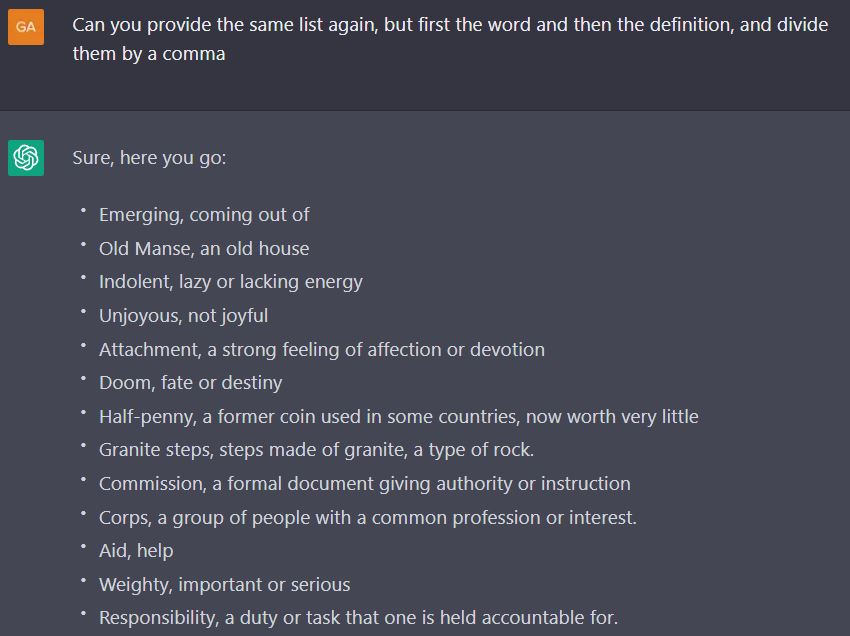
This is where Chat GPT comes in. Let’s say you are a student learning English, and you come across a news article or reading text from a lesson that has a lot of vocabulary words that are new to you. You can ask Chat GPT to define the words, provide translations, provide example sentences, and then format the words as a list of vocabulary terms separated from their definitions (or examples, translations, etc.) by a comma. The formatted list that Chat GPT produces can then be uploaded directly to Anki to create a new study deck. 


Key Phrases for this Chat GPT Study Method

“Identify all the difficult vocabulary words in this paragraph.”

“Define the words, and provide them as a list with the word first and then the definition/translation, and divide them by a comma.”

“Provide a list of words and their definitions related to the same topic as this paragraph, and divide the words and definitions using a comma.”


A Visiting Scholar's Tips for Becoming Fluent in English Without Spending a Lot of Money, with Daniel Mikesell

 A Challenging Question


Taiwanese students and parents face an interesting challenge. The importance of becoming fluent in English before attending overseas universities cannot be understated, but which of the many routes to fluency is the most effective and efficient?


Taiwan is a country that started integrating English education decades ago, and most Taiwanese people can read and understand basic English; however, many Taiwanese are not confident in their speaking ability, and, statistically speaking, few qualify as fluent. 


There is an obvious, sincere, and longstanding desire to learn English in the general population, so why aren’t more people becoming fluent? Given the amount of time and money spent on learning English here, why aren’t most people conversationally fluent?


Problems in the English Education Market?


After many years working in Taiwanese international high schools and adult English institutions, and observing the various kinds of English learning marketed around Taiwan, I have pinpointed a few factors that contribute to the lack of realized potential. While I’m not necessarily here to point fingers, I will at least mention a few of the factors that seem to slow or prevent fluency.


  • Many Taiwanese after-school English programs don’t exist primarily to teach English. For many families, these schools serve other functions, such as after-school care for busy parents and homework-help centers. 


  • Mandatory public school English programs implement moderately successful teaching strategies but still focus on the types of learning that work much better for Chinese language studies than learning English, such as memorization and repetition, and some public school teachers don’t speak well enough themselves to teach students correctly.


  • Some so-called “international schools” in Taiwan accept students whose English proficiency is far too low to enable the students to succeed in an all-English, academic environment. Students who can’t carry on a casual conversation in English for a few minutes certainly can’t read and analyze literature or interpret scientific data in English, and they are left behind as they try to catch up on learning English, without the school’s help, while juggling demanding academic coursework. Frankly, no student should be put through that. Everyone has the potential to learn a language, but many students are set up to fail .


  • Some cram schools overemphasize the importance of standardized language proficiency tests and make promises about learning results that they can’t back up. Cram school English classes are wildly popular, but they are probably the least genuine, least regulated, and least effective options for learning English. Some schools provide good services, but they all make money whether or not their students learn English.


It’s Up To You


Taiwan’s persistent quest to increase the level and amount of English fluency on the island is commendable, impressive, and makes foreign language teaching in American public schools look like a joke. (Most American students take two years of extremely watered-down language classes and are never required to demonstrate any real mastery at any level.) However, the fact that many Taiwanese people speak some English has little or nothing to do with any individual student’s likelihood of mastering English.


A shift in mentality must occur - a person who sincerely plans to become fluent in a language accepts that they must individually bear most of the responsibility for their own success. Parents can pay schools as much money as they want, but at the end of the day, students must use the resources at their disposal and their own precious time if they want to truly be successful. 


This is not to say that no one needs help. This does not mean that parents, teachers, tutors, classes, and resources are irrelevant. However, you’ll find that, short of a year or two of full-time, intensive language training through a reputable program, the most effective and efficient methods of learning a language are mostly self-guided. 


No Strings Attached


On that note, I would like to share with you some tips for learning English fluently, without spending an arm and a leg, from an old friend, and a true example of a self-guided language learner:


  • Daniel Mikesell is an international teacher who has guided students at schools in four countries and is now a master’s student at The Hopkins-Nanjing Center, a branch of Johns Hopkins SAIS, and a visiting scholar in the Department of Political Science at National Taiwan University, where all classes and assignments are conducted in Chinese. Daniel is an American who largely taught himself to read, write, and speak Chinese. When I first met Daniel while teaching in China, he was deep in the process of learning Mandarin Chinese. Often, when I would ask Daniel how he was doing, he would reply that he woke up in the middle of the night and studied Chinese for two hours. That was in addition to his rigorously scheduled self-study sessions and lessons during the day. Daniel has a passion for languages (he has also studied Italian, Japanese, and Arabic), and he knows many effective methods for self-teaching. He would like to share a few of those methods with you.


How can Taiwanese students learn to speak fluent English without spending lots of money?


Taiwanese students learn basic English in school, but there’s a huge gap between textbook

English and authentic English. In five years of teaching English across the USA, Japan, Italy, and China,

I’ve met many students whose parents spent a fortune on their education, yet they failed to learn English. On the

other hand, I’ve also met students whose parents lack financial resources who learned to speak like native

speakers. I’m convinced that parents don’t need to spend lots of money to help their children become

fluent in English.


Why do you care?


It’s simple: I care deeply about bridging the gap between cultures and I believe that helping students learn foreign languages is the best place to start.


What can students do in order to guide themselves to learn English at a high level?


  1. Set aside time every week for watching English-language TV. Start with short, light TV shows, not full-length movies or complicated documentaries. When watching English-language TV, use English subtitles – and only English subtitles! Never use Chinese subtitles! This point is critical. If Taiwanese students use Chinese subtitles, their brains won’t be forced to think in English. It’s true that Chinese subtitles would aid their understanding, but the purpose is to improve their English, not to understand every detail of the show.


  1. Use free English-language internet resources. In my experience, the two most helpful resources are Youtube and Anki.

    1. Youtube is filled with English lessons, and I’ve met dozens of people throughout the world who taught themselves English primarily through Youtube.

    2. Anki is a free computer software which utilizes the Pimsleur method, an effective language-learning method based on the concept of graduated interval recall. Pro tip: Use Anki flashcards with short sentences, not individual vocabulary words!_

    3. Follow English-language social media influencers on Instagram. Influencers tend to teach slang and other non-textbook phrases that are useful in everyday life.


  1. Listen to English language music and lyric videos on Youtube. Through these videos, you’ll improve your English while simultaneously gaining insight into foreign cultures.


  1. Participate in English-language discussion forums on Twitter. These discussions will familiarize you with ways native speakers communicate on the internet.


  1. Browse the headlines of foreign news websites like Reuters and the BBC. This is one of the best ways to learn how to discuss complex issues related to politics and business.


What can parents do to help their children?


Parents can help their students by moving beyond mainstream ideas about learning English. Groupthink is hard to overcome, especially when everyone is under so much pressure, but non-traditional methods can really help! If your children are watching TV or surfing the web, they’re not necessarily slacking off – as long as they’re doing it in English! Reciting vocabulary might help for taking tests but it won’t help students speak like native English speakers. Most importantly, don’t believe people who say you need to spend lots of money to help your children learn English. The key is to utilize the resources that you already have at your disposal!


Daniel Mikesell taught English for five years across the USA, Japan, Italy and China. He is currently a master’s student at The Hopkins-Nanjing Center, a branch of Johns Hopkins SAIS, and a visiting scholar in the Department of Political Science at National Taiwan University.


Email: danieljmikesell@gmail.com


Line ID: daniel.mikesell


Monday, January 30, 2023

Chat GPT and the Future of Student Writing by Jared Gamble, editor


                                                                   Photo by Kaitlyn Baker

Revolutionizing education one chat at a time: Chat GPT transforms the way students write with its cutting-edge AI technology.

I didn't write the sentence you just read. The Chat GPT artificial intelligence program wrote it for me. 

While this one sentence might not seem terribly impressive, it's worth considering that I could have told Chat GPT to write two sentences. Or an outline. Or a paragraph. Or an email. Or an essay. Or a novel. Or even a computer code. And Chat GPT could do it. 

The sentences that Chat GPT wrote for me were not copy-pasted from the internet by the program, and if I ask Chat GPT to write the same thing again, it will generate a different sentence. In fact, here's the second attempt:

"Say goodbye to writer's block and hello to effortless writing with Chat GPT, the revolutionary AI tool transforming the way students express their thoughts and ideas!"

If you're a student, you might be thinking, "Wow! I can use this program to do my homework!", and you wouldn't be wrong. If you're a parent, your response might be a little different. Most likely, you have a lot of questions.

So What is Chat GPT?

Chat GPT is an artificial intelligence program created by Open AI that is, according to the program itself (yes, I asked the bot to explain its own existence), "a state-of-the-art language model developed by OpenAI" that "uses advanced artificial intelligence techniques to generate human-like text based on the input it receives." According to Chat GPT, "It has applications in various industries, including chatbots, customer service, and content creation."

Interestingly, Chat GPT's description of itself doesn't mention anything about its ability to write surprisingly coherent essays on virtually any academic topic. That is to say, it doesn't mention its ability to help students cheat. By now, hundreds of articles and blog posts about the program's abilities and potential for changing education, both positively and negatively, have been published globally. For students in Taiwan who mostly learn English as a second or third language and have to work much harder than native speakers to master academic writing, Chat GPT could be a game changer. However, the program's usefulness depends on not only the way students use it, but also on whether or not the education industry finds a way to curb its power.

The Clock is Ticking for this New Technology

The education industry is usually slow to respond to advances in technology. Generally speaking, students learn of, try, and master new technologies years before educators incorporate those technologies into their teaching. Schools' responses to any given technology, website, social media app, or electronic device are largely reactionary, with some educators and schools limiting or banning, and with others embracing and incorporating. For example, some high schools ban the use of cellphones entirely, while others encourage teachers to use teaching methods that rely on them. 

However, this mixed response might not be the case for schools' responses to Chat GPT and other artificial-intelligence-based programs. Soon after the program was made available to the public, it became clear that cheaters now have everything they need to pass reading-and-writing based courses without actually learning to write well, and some parts of the education industry are already responding by implementing new software designed to detect AI-generated text. If you ask me though, I would bet it will be a long time before schools in Taiwan aggressively move to prevent students from using Chat GPT, if they ever do.

There's No Use Fighting the Inevitable

As a long-time public and private school teacher turned freelancer, it's really interesting for me to consider how something like Chat GPT could help or harm students in the long run. If you had asked me several years ago whether I think students should be allowed to use artificial intelligence programs to help them write, I would have responded no, firmly. But now, without being responsible for representing the policies of a school as an employee, two things seem obvious to me:

1. There is no stopping artificial intelligence. It is already a bigger part of society than most of us realize, and it will make its way into our daily lives very soon.

and

2. Students and parents can use Chat GPT as a tool without cheating or crossing ethical lines. Math teachers thought it was the end of the world when the calculator was invented. English teachers thought the proliferation of TV and movies would stop people from reading. They were all wrong. Students can learn from Chat GPT, not just use it to cheat.

Making Use of New Technologies to Benefit Students

Read about Chat GPT. Try it out yourself. See what it can do. It's so good at what it does that last week, Microsoft invested in Chat GPT's creator  company Open AI for the third time. For your student's sake, please have a conversation about ethical uses of technology and the importance of not cheating. Then, guide them to use Chat GPT wisely using some of the strategies in my other blog post, Using Chat GPT As a Self-Teaching Tool: A Guide for Students and Parents


What It Really Means to Be Bilingual by Rosie Byrnes

  What It Really Means to Be Bilingual by Rosie Byrnes We know that there are many benefits of being bilingual, especially in an increasingl...